Table manners
How to join a Georgian toast
Etiquette for a first Georgian table: waiting for the tamada, what to say when a toast reaches you, pacing, and how little of it a hosted dinner night asks.
Book the Tbilisi dinner and dance night ↗Quick answer
Wait for the tamada, hold your glass during a toast, and speak a few warm words when it reaches you or simply drink after words that resonate. Eating while toasts are spoken is fine; talking over the speaker is not. On the Tbilisi hosted night nothing formal is asked of you: your host leads, and lemonade and water are included.
Let the tamada start
At a family supra the tamada opens the toasting, and guests wait. Wikipedia explains that the tamada proposes a toast and speaks about it at some length while guests raise their glasses but do not drink. Only when the tamada has finished does the toast pass on. If the family chose the tamada in advance, the senior family member begins by proposing the first toast to the tamada, and everyone drinks that one quickly, almost in unison, with a fixed phrase or two.
When the toast reaches you
After the tamada, the toast continues around the table, often counter-clockwise, and each guest who wishes to speak raises a glass, speaks and drinks. Wikipedia says guests often vie to say something more original and emotional than the last speaker, so the evening becomes a kind of oratory contest. You do not have to join in. A guest who does not want to speak may drink after words that resonate with them, and the toast moves on.
Praise is the point
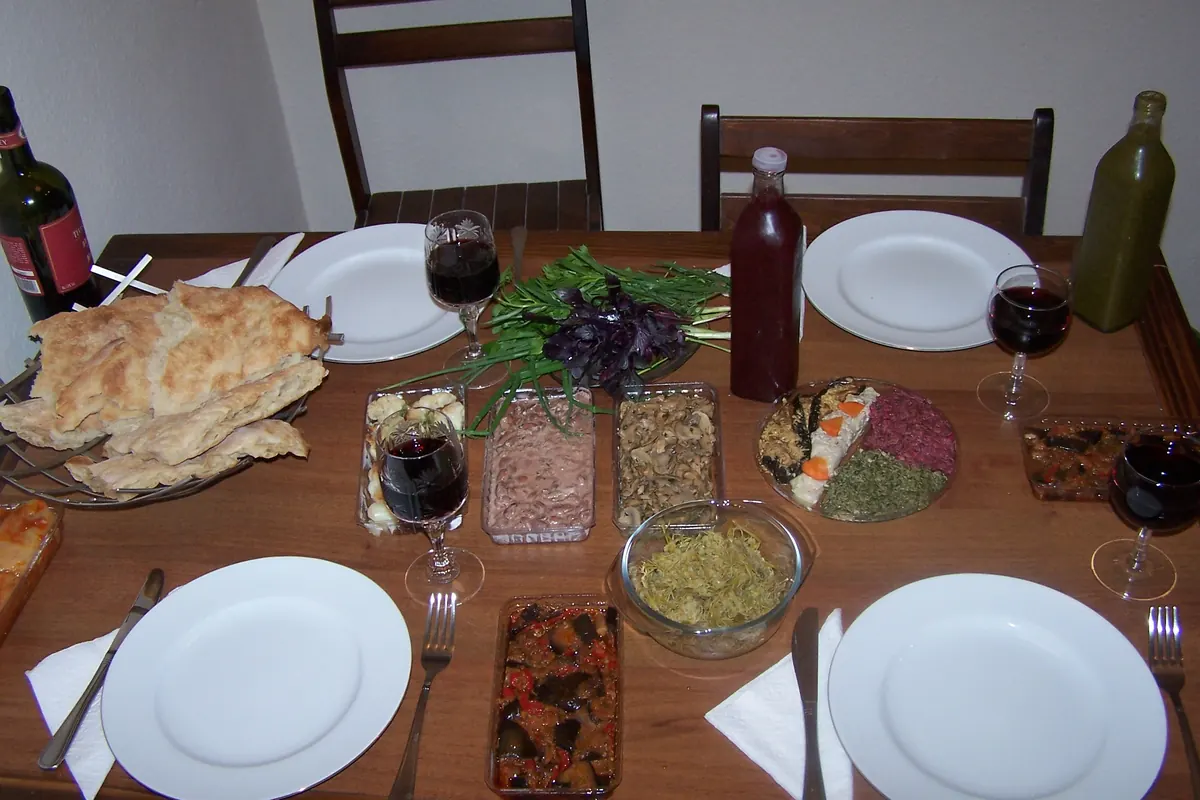
The article on the tamada explains that both tamada and guests are expected to toast every person at the table, and that each speaker looks for the most interesting, original and praiseworthy features of the person toasted. Georgians, it says, do not consider this flattery but a way to encourage good traits: tell a person they are generous and they will try not to be greedy. A short, specific, kind sentence about the person beside you does the job better than a long speech.
Eating, talking and pace
Eating during toasts is entirely appropriate, Wikipedia says, but talking is frowned upon. The tamada controls the pace: toasts come faster early in the evening and slow later, and a good tamada senses how much people have drunk and adjusts. The tamada is expected to empty a glass for each toast, yet the article calls it disgraceful for a tamada to get drunk. A supra also pauses for songs and dances between stretches of toasting.
Songs and dancing between toasts
A supra is not only speeches. According to Wikipedia, the tamada is expected to orchestrate singing or dancing between stretches of toasting, so that people stay attentive and entertained. Kakheti table songs usually feature a long drone bass with two soloists singing the top two parts, and UNESCO describes this polyphonic dialogue over a bass background as prevalent in the region. Feast songs include mravalzhamier songs and Zamtari, sung to remember ancestors. On the Tbilisi night, a professional folk-dance show takes the place of the singing, and an open dance floor follows.
Leaving the table
In the past the tamada had more control over the table than today. Wikipedia notes that members of a supra were expected to ask permission before leaving, and if they got it, the tamada and others could toast them as they went. That formality has softened, but a short word to the host before you leave is still good manners, and a toast to the people you are leaving is a graceful way to go. At a restaurant, simply thank your host.
What the hosted night asks of you
Very little. The Tbilisi dinner-and-dance night is a hosted group dinner at shared tables, with a host who speaks English and Russian, a folk-dance show and an open dance floor later. A formal tamada and a structured round of toasts are not promised, so any toast you hear is a bonus. Homemade wine, lemonade and water are all included, so you can raise a glass of whichever you prefer. Listen, smile, say thank you, and join the dancing if you feel like it.
Frequently asked questions
Can I refuse to drink at a Georgian toast?
In the tradition, a guest who does not wish to speak may drink after words that resonate. On the Tbilisi dinner night lemonade and water are included, so you can raise either.
Do I have to make a speech?
No. Guests who want to speak raise a glass and add a few words; others simply drink and let the toast move on.
Will there be a tamada on the hosted night?
The ticket does not include a formal tamada. Your host leads the evening, and any toasts are a bonus.
Sources